
How to Measure for a Stair Runner 2027

By Keith Shannon, a real carpet and stair runner installer for 25+ years, and owner of DirectCarpet.com. Follow my installs on Instagram and YouTube.
Updated November 2026
Wondering about price? See what your stair runner will cost.
What this guide covers
- The 19-inch rule: how long a stair runner you need, with video.
- The #1 measuring mistake, and why you never order it exact.
- How wide your runner should be, and how much wood to show.
- Landings, U-shapes and pie stairs: what to measure and what to order from our stair runners store.
- A length cheat sheet, the calculator, and the questions people ask most (FAQ at the bottom).
The short answer: How do you measure for a stair runner? Count your stairs, add half a stair for the top riser, multiply by 19 inches, then divide by 12 to get feet, and round up. For stairs with a big, deep nose use 22 inches instead of 19. Example: 12 stairs is 12.5 × 19 = 237.5 inches ÷ 12 = 19.8 ft, so you order a 20 ft runner.
Quick facts from a 25+ year installer
- Rule of thumb: 19 inches per stair, 22 inches for deep-nose stairs.
- Always count the top riser as half a stair. 12 stairs = 12.5 stairs.
- Never order it exact. If you tape-measure it yourself, add an extra 1 to 2 feet.
- Most popular sizes: 20 ft (12.5 stairs) and 28 ft (17.5 stairs). Past 28 ft we custom make it.
- Width: aim for a 3 to 4 inch reveal of wood on each side. We cut any width.
- Landings come 4 ft × 4 ft, so you don't need to measure a left or right turn landing.
- Pie stairs: you make a paper template, we make the pieces.
Watch how I measure a staircase for a stair runner. Watch on YouTube
How to Measure for a Stair Runner in 5 Steps
- Count your stairs. Count every step, then add half a stair for the top riser going up to the hallway or main floor.
- Check one step. Run your tape from the bottom of one riser, over the nose, to the bottom of the next riser. Most stairs come out around 18 to 18.5 inches, and we allow 19. A big, deep nose? Use 22.
- Do the math. (Stairs + ½) × 19 ÷ 12 = feet of runner. Or punch it into our stair runner calculator.
- Round up. Always order the next size up. A little extra gets trimmed off at the top; a runner that's too short can't be fixed.
- Measure the width. Stringer to stringer, then take off 6 to 8 inches so you show 3 to 4 inches of wood on each side.
The #1 Measuring Mistake
I think the worst thing you can do when you're measuring for a stair runner is try to measure it exact, by taking a tape measure and measuring from the top down or the bottom up and saying, "I need 17.5 feet to do my stairs." That's not going to be accurate. If you add underpad, you're going to add an extra inch to each stair. When you tuck it into the grooves, you're going to lose 1/8 of an inch to 3/8 of an inch. It depends. So when you measure your stair runner, you should add an extra foot to 2 foot after. If you use our measuring guide, you can figure it out easy for yourself.
Why 19 inches? Stairs are really only about 18 to 18.5 inches per stair. We already allow 19 inches per stair, so the extra for your underpad and tucking is built right in. Trust the professional, it's fine.
The other one I see all the time: forgetting the top riser. People count their treads and measure one step, but they forget the last 6 to 7 inches going up to the hallway or main floor. Count it as an extra half stair and you're covered.
How Long Should My Stair Runner Be?
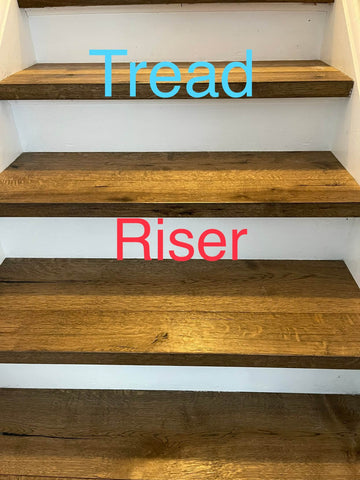
Every standard step uses about 19 inches of runner. That covers the tread (the part you step on) plus the riser (the vertical face). Multiply that by your number of stairs plus the top riser, divide by 12, and round up.
Deep-nose stairs: 22 inches per step, absolutely correct. If your stairs have a big, chunky bullnose or extra-deep treads, use 22 in the formula instead of 19.
Measuring step by step (with photos)
1. Measure one tread and riser together. Put your tape at the bottom of one riser, run it over the nose of the step and down to the bottom of the next riser.
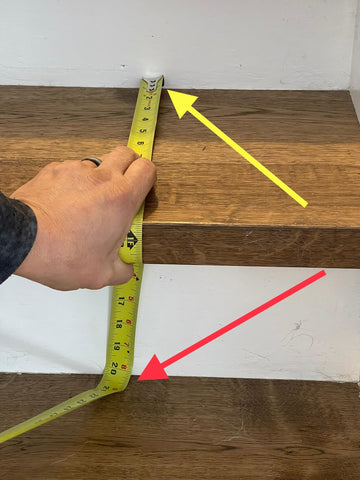
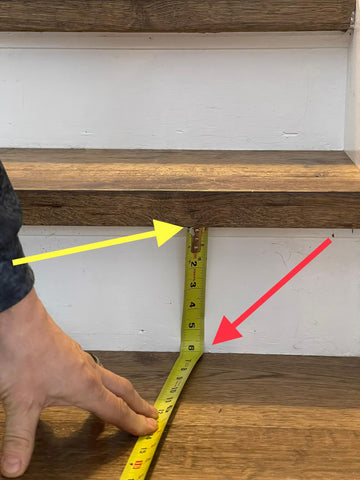
2. Measure the top riser. Every staircase has one extra riser at the top going up to the hallway or landing. Put your tape under the nose of the top step down to the bottom of that riser. That usually adds 6 to 7 inches.
Stair Runner Length Cheat Sheet
Here's my cheat sheet. Each length covers this many stairs, counting the top riser as half a stair:
| Runner length | Will do |
|---|---|
| 18 ft | 11.5 stairs |
| 20 ft | 12.5 stairs |
| 22 ft | 13.5 stairs |
| 24 ft | 14.5 stairs |
| 26 ft | 15.5 stairs |
| 28 ft | 17.5 stairs |
| Over 28 ft | Custom made |
Longer than 28 feet? Usually people don't need anything past 28 feet. 28 feet does 17.5 stairs. We had a customer the other day that wants 32 feet. We will custom make it.
Between two sizes? Always order the longer one. A few extra inches gets trimmed and hidden; a runner that's too short can't be fixed.

How Wide Should My Stair Runner Be?
A stair runner should be about 6 to 8 inches narrower than your total stair width, which leaves 3 to 4 inches of wood showing on each side. I like a 3 to 4 inch reveal. Showing some wood, it looks nice, but I mean, it's all personal preference.
- Covering up older, scratched or marked-up stairs? Show less wood. A 2 to 3 inch reveal on each side hides more of the imperfections.
- Beautiful new or freshly refinished hardwood? Show it off. A 4 to 6 inch reveal on each side lets that wood shine.
- Older, slightly crooked stairs? A wider reveal actually helps. It disguises steps that aren't perfectly straight.
Measure stringer to stringer. Measure the full width of your stairs from side to side. For example, a 36-inch staircase with a 28-inch runner leaves 4 inches of wood showing on each side.
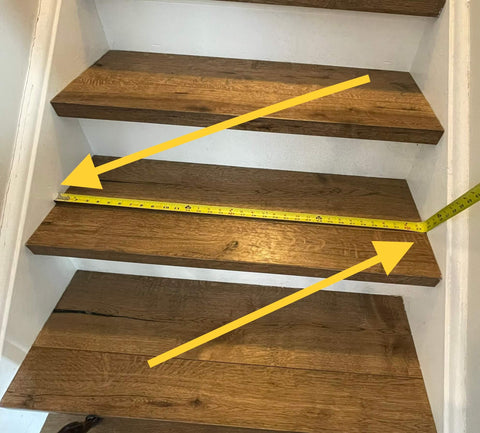
Custom widths: We'll cut any width that you need. We try to stay within the pattern, because you don't want to be off pattern. The most popular widths on DirectCarpet.com are 26 and 28 inches, with 28 inches the favourite.
Landings, U-Shapes and Pie Stairs
Left turn or right turn landing (90 degree)
To order from us, you don't have to measure your left turn. You don't have to measure your right turn, because all of our landings come 4 feet long by 4 feet wide. If you are ordering, let's say, a 27-inch stair runner, you're going to order the matching 27-inch left or right turn landing.
U-shape landing (180 degree)
When you order a U-shape landing, we will send you a video on how to get those measurements to us. Here's how it works: how to template and measure a U-shaped landing.
Pie and winder stairs
You can order pie stairs from us. We're just going to show you how to make a paper template. You make a paper template, send it to us following our video, and we can make them. We have pie packages. Step by step: how to template pie-shaped stairs.
How we install a stair runner on pie-shaped stairs. Watch on YouTube
Patterned runners
Herringbone and stripes: order a little extra so the pattern lines up on every step. If you're not sure, ask us before you order.
Best Materials for a Stair Runner
- Nylon: the most durable, lasts longer, great for high-traffic homes.
- Polyester and polypropylene: easier to clean, a good pick for pet owners.
- Wool: natural, hypoallergenic and long-wearing, but the most expensive.
Why wool? Wool is hypoallergenic. It's a natural fiber. It wears well. And if people really want a natural product in their house, wool is the way to go. The downside, obviously, is the price. Wool is super, super expensive. Cleaning, it's going to clean; it depends on what you spill on it. Pets? Wool is a tight weave. It's strong, it's durable, it's going to last. Pets can run up and down it, no problem.
Coming soon: we're bringing in Stanton wool stair runners.
Read our full material guide: polyester vs. nylon
Next: Install It
Once you have your measurements and your runner, here's my full step-by-step install guide with videos: How to Install a Stair Runner 2027.
Shop Stair Runners


We make great stair runners and help dogs in need.
Every stair runner we sell helps fund dog rescue in Puerto Rico. Dogs don't like hardwood stairs, their nails can't grip. A runner fixes that. See our dog rescue work.
How to Measure for a Stair Runner: FAQ
How do I measure my stairs for a runner?
Count your stairs, add half a stair for the top riser, multiply by 19 inches, and divide by 12 to get the length in feet. For example, 12 stairs = 12.5 × 19 ÷ 12 = 19.8 ft, which you round up to 20 ft. Or use our stair runner calculator.
Can I order the exact length I measured?
No. If you tape-measure your stairs and order exactly that, you'll come up short. Underpad adds about an inch a stair, and tucking it into the grooves takes a bit more. Add an extra foot to 2 feet.
How long should a stair runner be for 12 stairs?
About 20 feet for 12 standard stairs plus the top riser. For deep-nose stairs, use 22 inches per step: 12.5 × 22 ÷ 12 ≈ 23 ft.
How many stairs does a 28 ft stair runner cover?
28 feet does 17.5 stairs. Past that, we custom make it. We just made a 32 ft runner.
How wide should a stair runner be?
About 6 to 8 inches narrower than your stairs, so you show 3 to 4 inches of wood on each side. We cut any width you need, and 28 inches is the most popular.
Should I include the top riser when measuring?
Yes. Count it as an extra half stair, or your runner will come up short at the top.
Do I need to measure my landing?
Not for a left or right turn landing. All of our landings come 4 ft by 4 ft. Just order the landing in the same width as your runner. For a U-shape landing, we send you a video on how to get us the measurements.
Can I get a stair runner for pie or winder stairs?
Yes. You make a paper template following our video, send it to us, and we make the pieces. See our pie stair package.
Should I round up or down?
Always round up. Extra gets trimmed and tucked out of sight, but a runner cut too short can't be saved.
Do you sell wool stair runners?
We're bringing in Stanton wool stair runners. Wool is hypoallergenic, natural and wears well. The downside is the price; wool is super expensive.

About Keith Shannon
Keith has been a professional carpet and stair runner installer for 25+ years and owns DirectCarpet.com, where every stair runner is cut, bound and shipped from our own workroom. On his YouTube channel he shows homeowners how to measure and install a stair runner themselves.
Through our stair runner sales, Keith funds dog rescue in Puerto Rico. Our dog charity work



Agree. Great info. Yet I need idea on how to measure a curved or wide to narrow staircase. I’m assuming I might have to order separate (and graduating m) sizes or separate pieces to accommodate different widths. Would love your help
Outstanding videos! You really do a great job explaining the process. How do I measure my two
Pie shaped steps for the runner?
Can you please provide instructions for measuring a winding/curve staircase for custom cutting? Thank you!
How do I measure only my treads I have 12 treads @ 36 1/8” wide X 12 1/2” deep and one landing 38” deep X 36 1/8” wide. I only want to carpet my treads only. My residents is non Loveland co and love your DIY!!!!! Pls let me know so I can order from you guys and I will be doing the installation myself. I have the tools already.
Leave a comment