

How-To Install Your Stair Runner
By Keith Shannon, founder of Direct Carpet and a professional stair-runner installer for over 25 years.

A staircase is the center-piece of your home. And it is not just about safety — it is for expecting mothers, for the elderly, for people with pets, and honestly, a lot of people just want one because it is the first thing you see when you walk in the door. There are a lot of reasons to put one down, and then there is the general safety on top of all of it.
I am Keith Shannon, and I have been a master installer for over 25 years. We are all installers here — everything on this page comes from an installation point of view, not a sales one. We have installed every carpet we sell and recommend, so we know how they work and how they feel.
One thing up front: this is a DIY guide. It is how someone at home can install their own stair runner with a minimal amount of tools — not a course on going pro. Follow along and your stairs will look great.
Quick Answer: How Do You Install a Stair Runner?
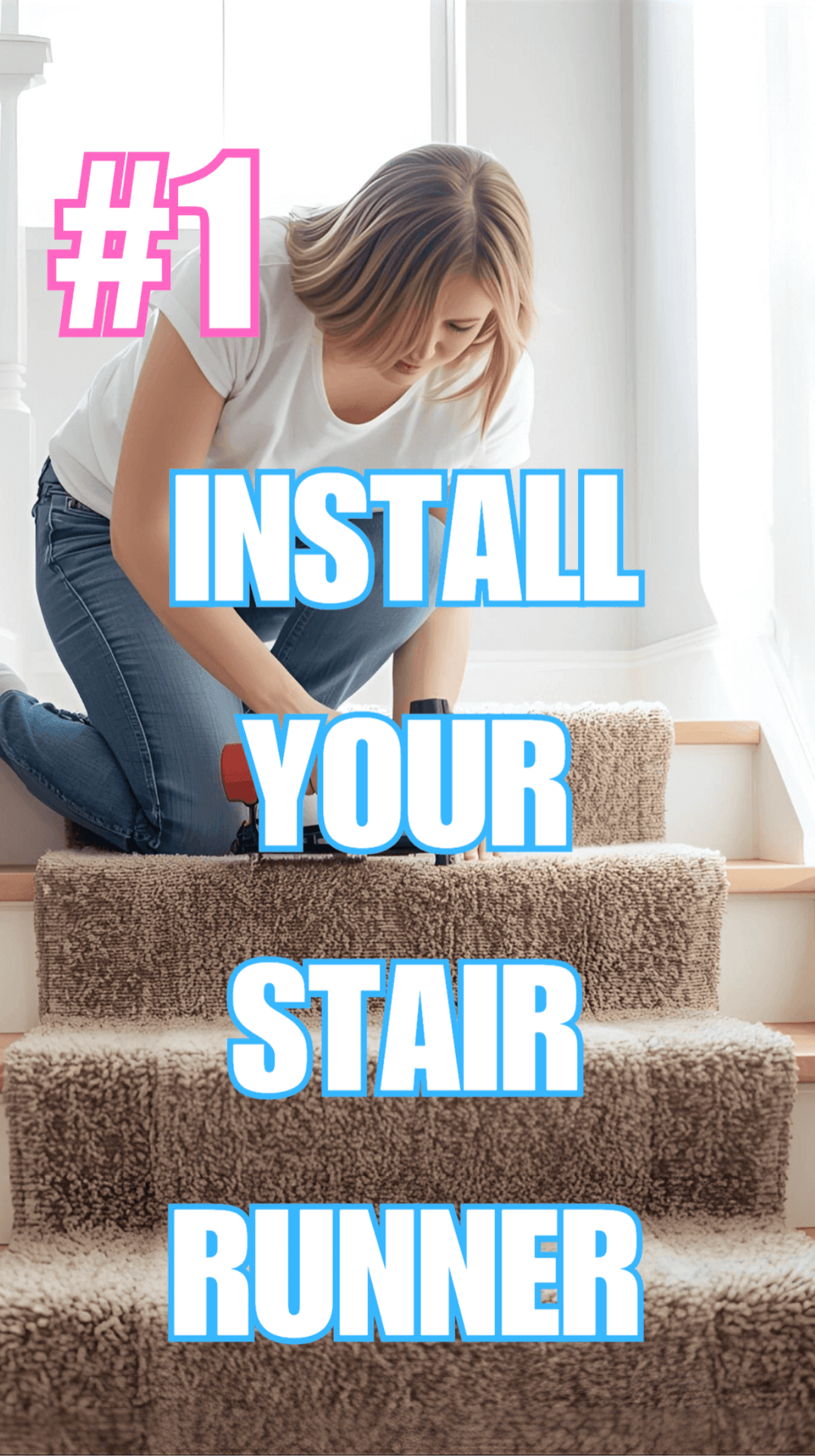
Very carefully! There are a few methods — tack strip, staples, or a combination. What we like to do is start at the bottom and work up the Staircase with an electric staple gun. Lay your padding first and center it, This Makes it Easier when Centering the Stair Runner, then run the carpet up the middle, use a spacer on one side to keep it dead straight, staple onto the nose of each stair, and use a stair tool to crease it in tight so it conforms to the step. Keep it tight, keep it straight, and give it a few hours.
What You Will Learn (with our tutorial videos)
- How to install a stair runner fast and efficiently
- How to keep it straight and install your underpad
- How to finish the top — the part everyone struggles with
- Left-turn, right-turn, U-shaped, and pie-shaped (winder) landings
- The full tool list, and where to buy or rent everything
What Is a Stair Runner, and What Are the Benefits?
A stair runner is a decorative strip of carpet that runs down the center of your stairs, but it is not only decorative. It is great for safety. Socks on slippery oak stairs? That is trouble. A runner will not stop a fall, but it definitely helps prevent one. In fact, a lot of insurance companies in the States will not even insure you if you do not have a runner on slippery wooden stairs, so it may even help bring your premium down. (Do not quote me on that, but safety is a real factor.)
What Size Stair Runner Should I Get?
It comes down to personal preference and the character of your staircase. Say you have a 36-inch-wide staircase: a 30-inch runner leaves 3 inches of wood on each side, and a 28-inch runner leaves 4 inches on each side. It just depends how much wood you want to see. Some people love showing off their wood; others want to cover almost all of it, especially on older, painted stairs.
Which Pattern Is Best for Stairs? (A Secret Most Stores Will Not Tell You)
Here is something almost nobody talks about, because most stores have never actually installed a runner, they are just Sales People. Everyone obsesses over the design. But the real trick is how the pattern plays with your stairs.
No staircase is ever perfectly straight, and no installer is perfect. So if you choose a carpet with horizontal lines, lines running across the step, those lines will show every little bit of crookedness, and you will never un-see it. But go with a linear, parallel pattern, herringbone or anything with the lines running down the staircase, and the pattern runs parallel with the stairs, so it actually elongates them and never looks off. The imperfections just disappear.
That is exactly why most of our carpets do not have horizontal lines. We pick patterns that make your stairs look longer and hide the imperfections, because we install these for a living. It is a big reason herringbone is our most popular pattern.
What Tools Do I Need?
A knee kicker, a tucker (stair tool), a good utility knife with sharp blades, 9/16-inch crown staples, an electric staple gun (a Dual-Fast or a Roberts), a glue gun, a generic hammer, and a tape measure. You can make your own spacer out of a scrap of underpad. That is pretty much it. You can rent most of these at Home Depot or any rental place like United Rentals.
How Much Carpet Do I Need? (The Measuring Rule)
Our rule of thumb: allow 19 inches per stair, and we almost always include the top riser, so 12 stairs is really 12.5 stairs. The formula is 19 times (number of stairs, plus 0.5 for the top) divided by 12 equals the feet of runner you need.
| Stairs | Runner length |
|---|---|
| 12.5 stairs | 20 feet |
| 13.5 stairs | 22 feet |
| 14.5 stairs | 24 feet |
| 15.5 stairs | 26 feet |
| 17.5 stairs | 28 feet |
| 18.5 stairs | 30 feet (custom) |
Or skip the math with our Stair Runner Calculator: punch in your stairs and width and it gives you the length.

How to Install a Stair Runner: Step by Step
Step 1 — Prep the stairs. Clean your wooden stairs and pull any old staples if there was a runner there before. Make sure the surface is ready for your makeover.
Step 2 — Center and lay the padding first. This matters: center your pad first, because if the pad is centered it is a lot easier to keep your carpet centered all the way up. Cut the underpad about 1 inch shorter on each side than the runner, so there is a place on both sides for the carpet to be stapled or glued, Tack it down with a hammer tacker.
Step 3 — Tack strip or staples? It depends on the backing. With Feltback carpet, tack strip tends to rip the backing, so use staples. With jute-back or action-back, tack strip is perfect, and you can use a combination of both. Know your backing first.
Step 4 — Start at the bottom. Center the runner at the bottom step using your spacer on one side, fold the edge down to the bottom of the first stair, and staple along the edge with your 9/16-inch crown staples.
Step 5 — Kick, crease, staple. Bring the runner up. Use the knee kicker to keep it snug, and note, we do not really kick it, we lean pressure into it to hold tension. Then work the stair tool into the crotch of the step, back and forth, to crease it tight so the carpet conforms to the 90-degree angle. Staple along that groove. (Installing top-down instead? Then you do not need a kicker, I am just more experienced bottom-up.)
Step 6 — Keep it tight and straight all the way up. Run your spacer up one side the whole way. This is the most important thing: tight and straight. You can be off by as much as a quarter inch and the eye will not catch it, but if it is crooked or loose, you really have not done your job. Keep checking as you go; stairs are often not straight even when they look it.
Step 7 — Finish the top. Trim the excess pad and carpet and staple along the bottom edge of the lip of the top stair. Finishing the top clean is what separates a good job from a great one (full method in the FAQ below). Remember, it is a piece of material, so work it and crease it to conform to those 90-degree angles. A little elbow grease, a few hours, and you are done.
Pro Techniques for a Master-Pro Finish
- The spacer template. Stairs are liars: they look straight but they are not. Slide a scrap-underpad spacer against the stringer and push the carpet to it, so you are 100 percent consistent bottom to top. No math, no zigzag.
- The wiggle. On Berber, wiggle the gun tip into the pile so the loops move aside; the staple hits the backing and the loops snap back over it. Invisible install.
- Pre-bending. Berber is engineered to resist. Break the backing by hand over the nose before you pick up the gun so it stops fighting you and popping staples.
- Counter-sinking. Hammer and stair-tool every staple down into the wood for a deep, professional shadow line. If I can see your staples, you are not done, I want to see the groove.
- Seal every cut. A bead of hot glue on every cut edge; if you do not, that Berber frays in six months.
How Do You Install a Stair Runner on a Landing?
Landings are where most DIYers quit, do not. Before you cut, stop stapling on the 45-degree angle and staple straight down so your blade does not hit a staple. Squeeze the bubble out with your thumb and stair tool so there is zero air behind the carpet, then seal the seam with a bead of hot glue smoothed with a wet finger, and the seam disappears. We make landings in every shape, and here are the videos.
Frequently Asked Questions
How do you finish a stair runner at the top?
This is the one everybody gets stuck on, and it is actually fairly easy once you know the trick. Install your runner all the way up to the last riser and cut off the extra, leaving about an inch or two to work with. Crease it really well. Then take a sharp blade and cut from the left, on the outside of the binding, careful not to cut into your wood or backing riser, and cut to the metal. Do the same from the right: cut to the metal. Pull the piece off, blow out all the fluff, and tuck it down with your stair tool. Now measure your riser, and measure each side separately, because stairs are rarely perfectly straight (it might be 5 inches on one side and 5 and a quarter on the other). Cut your finished-edge piece to that measurement and fit it into the riser. Done right, it looks invisible and seamless, and no one will ever know it is not one continuous piece.
Nylon vs polyester vs polypropylene, which is better for stairs?
They each have a trade-off. Nylon is more durable and lasts longer (and often comes with a Scotchgard treatment). Polyester and polypropylene are usually easier to clean. So it comes down to what matters most to you: nylon lasts longer, poly is easier to clean.
What size staples should you use for a stair runner?
9/16-inch crown staples.
Can you install a stair runner over existing carpet?
You absolutely can, but not with the normal methods. You need to use decorative bars with a screw on each end, so you have a screw long enough to go through the original carpet and into the stair. Regular staples will not hold through an existing carpet.
Waterfall or cap-and-band, which is better?
There is no better, it is a decorative choice. Waterfall is the original; it goes back to the old days (think Scarlett O'Hara!) because it was invented before electric staple guns, and they used decorative bars to hold it. The one advantage of cap-and-band is that wrapping under the nose and capping it shortens the distance between tack points, so the runner stays tighter over time. The only downside is more staples under the nose, so it is more work to rip out later.
How do you keep a stair runner from sliding or moving?
A stair runner that is stapled on properly is not going to move, period. Where people get in trouble is grabbing some random material with stretch in it; step on that and it shifts, and that is genuinely dangerous on stairs. Underpad under a proper runner helps with any shifting, but a real runner installed correctly does not move.
Do I need tack strips, or can I install without nails?
Tack strip is fantastic, a piece with 5 nails only makes 5 little holes, versus the staple-gun method which puts in a lot of smaller holes. But here is the catch: a lot of our carpets are Feltback (a Shaw product), and with Feltback, tack strip does not work; it can severely rip the backing when you crease it. So for Feltback we recommend the staple-gun method. Tack strip was really invented for action-back or jute-back carpet, and it works great for those.
How long does it take to install a stair runner?
As a pro, I can do a bare straight flight in about an hour, a straight-with-a-turn landing in about an hour and a half, and a U-shape in about two hours. For a brand-new DIYer doing a straight 12.5-stair runner, there is no reason you cannot finish inside two hours, it is an afternoon. And so what if it takes you three or four hours? Some folks like to go slow. The right answer is: put it on straight, and put it on right.
Do stair runners help dogs on slippery stairs?
Absolutely. Here is a true story: I met a woman through dog rescue, she had two rescue dogs from South Africa and had just moved into a home with bare hardwood stairs. One of her dogs slipped, tumbled all the way down, and broke its back. She is an incredible person and rehabbed that dog back from the brink. Then she slipped on those same stairs and broke her arm. That is when she called us, and we put a runner down for both her and the dog. The truth is, dogs do not like hardwood, flat or on stairs, because their nails cannot get any grip. A lot of people end up carrying their dog up to bed and back down every day, and plenty of dogs are terrified of the stairs. Put a runner down, and once the dog learns to walk on it, it is comfortable, and honestly, it is fun to watch. (This is also why 10 dollars from every order goes to rescue dogs.)

Will the staples damage my hardwood stairs?
Honestly, 100 percent, they will. So will tack strip. So will glue. Everything damages the hardwood to some degree. But here is what most people do not realize: it is not just the staple holes, it is sun fading. Wherever the runner covers the wood, that strip stays the original color, while the exposed sides fade over time. So years later, the wood is dark and aged on the sides and bright and new underneath. It is worth knowing before you decide.
Pro Installer Secret: When we measure a home that already had, say, a 27-inch runner, we always bump the new one up to 28 or 29 inches. Why? Because of that fading. If we went back in under the old width, you would see the old fade line and staple marks on the exposed wood. Adding an inch on each side guarantees you cover up the old marks. That is how the pros make it look brand new.
Shop Stair Runners
- Shop All Stair Runners
- Herringbone Stair Runners
- Berber Stair Runners
- Order 5 Samples for 25 dollars
Every order helps rescue dogs in Puerto Rico and Canada.




Leave a comment